For most housing providers, leak is not a technical problem.
It’s a governance problem.
The underlying causes — moisture, cold surfaces, poor ventilation — are well understood. What breaks down is how information about those risks moves (or doesn’t move) across teams, systems, and time.
Centralised leak governance is about fixing that.
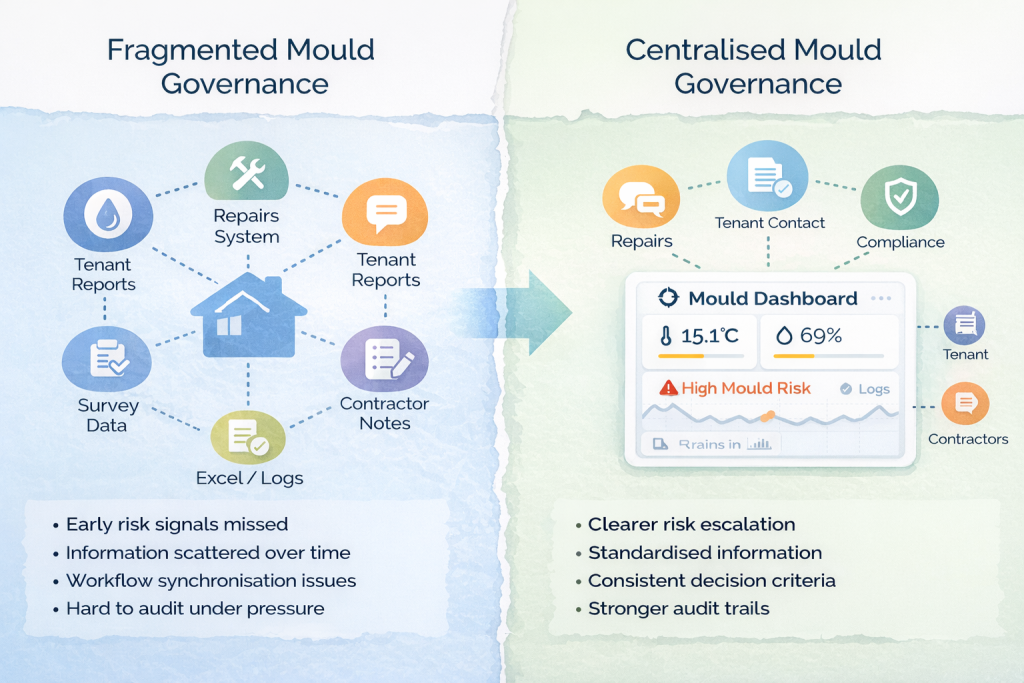
In many organisations, leak-related information is spread across:
repairs systems
survey reports
contractor notes
tenant communications
compliance logs
Each system holds a partial view. No one sees the full picture.
As a result:
early warning signs are missed
similar cases are handled inconsistently
teams default to reactive inspections
audit trails are hard to reconstruct under pressure
By the time leak becomes a formal compliance issue, the opportunity to intervene early has already passed.
Centralised governance doesn’t mean centralised control.
It means centralised visibility and decision-making criteria.
At its core, it answers three questions consistently across the organisation:
What do we know about conditions in this property?
How long have those conditions existed?
What action threshold does that trigger?
Instead of relying on individual judgement calls, teams work from the same shared evidence base.
Compliance failures around damp and leak rarely come from inaction.
They come from delay, ambiguity, and poor documentation.
Centralised governance helps by:
creating a single, time-stamped record of environmental conditions
showing when risks emerged — not just when they were reported
demonstrating proportional, timely responses
reducing reliance on retrospective explanations
When regulators or ombudsmen ask “what did you know, and when?”, the answer is already there.
Traditional workflows are built around inspections:
a visit
a reading
a report
These snapshots are useful, but limited. They don’t show:
persistence of risk
intermittent exposure
slow deterioration over time
Centralised governance shifts the focus from individual events to patterns and trends, allowing teams to prioritise:
which properties need intervention first
where inspections are actually necessary
where monitoring alone is sufficient
This reduces unnecessary visits while improving risk coverage.
There’s a common concern that better monitoring creates more work.
In practice, the opposite tends to be true.
When information is centralised:
duplicate inspections drop
repeat complaints are easier to contextualise
disputes are resolved faster
teams spend less time chasing fragmented data
Compliance becomes more predictable — and therefore more manageable.
Centralised leak governance also changes internal dynamics.
It moves conversations away from:
blame
assumptions
anecdotal evidence
And toward:
shared facts
agreed thresholds
consistent decision-making
That shift matters just as much as the technology behind it.
Leak compliance isn’t improved by reacting faster to visible problems.
It’s improved by seeing risk earlier, documenting it clearly, and acting consistently.
Centralised leak governance gives compliance teams:
earlier visibility
stronger audit trails
clearer prioritisation
fewer last-minute escalations
And in a regulatory environment that’s becoming more prescriptive, that kind of clarity is no longer optional.