
Most leak detection still relies on what people can see or smell. By the time leak is visible on a wall or ceiling, it has usually been present — and active — for weeks.
This is where mVOC sensing comes in.
mVOCs, or microbial volatile organic compounds, are gases released by microorganisms as part of their normal metabolic processes. When leak begins to grow, even at very early stages, it emits a characteristic mix of these compounds into the surrounding air.
Importantly, this happens before leak colonies are large enough to be seen and often before occupants notice any smell.
In simple terms, mVOCs are a by-product of biological activity. Detecting them is less about spotting leak itself and more about identifying that growth has already begun somewhere nearby.
Leak needs moisture, time, and the right conditions to become visible. During that period, activity is already taking place behind surfaces — inside walls, under floors, or within poorly ventilated cavities.
Traditional approaches tend to miss this phase. Visual inspections, surface swabs, or reactive callouts only capture problems once they have reached an advanced stage. At that point, remediation is more disruptive, more expensive, and more likely to affect tenants.
mVOC detection shifts the timeline earlier.
An mVOC sensor continuously measures changes in the composition of the air. Rather than looking for a single compound, it tracks patterns and trends associated with microbial activity.
This matters because indoor environments are complex. Cleaning products, cooking, or occupancy can all influence air chemistry. The value of mVOC sensing lies in monitoring change over time, not in reacting to one-off readings.
When mVOC levels rise consistently, it suggests that biological activity is increasing somewhere in the environment — often in areas that are not directly accessible or visible.
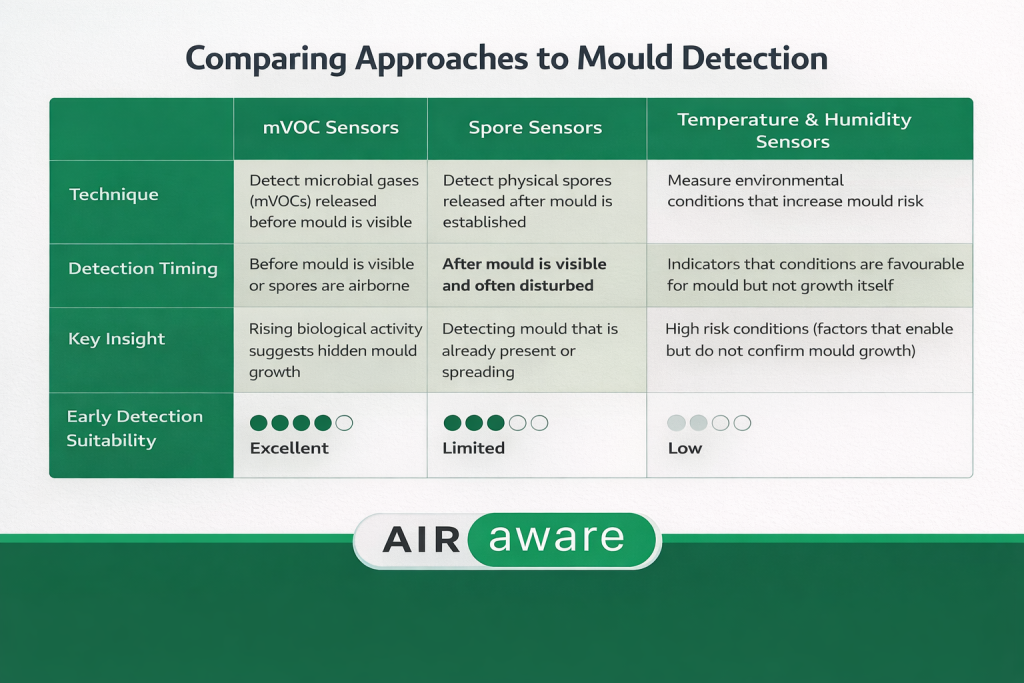
Spore-based leak sensors are designed to detect physical particles released into the air once leak colonies are established. In many cases, spores are most detectable when leak is already visible, disturbed, or drying out.
This makes spore detection useful for confirmation, but limited for early warning. By the time spores are present in measurable quantities, the underlying moisture issue has usually existed for some time.
mVOC sensing operates earlier in the process. It detects metabolic activity rather than airborne debris, providing a signal that growth is underway even when leak is still hidden within the building fabric.
In practice, the two approaches answer different questions:
Spore detection helps confirm that leak is present
mVOC detection helps indicate that leak is developing
For proactive monitoring and prevention, timing is the critical difference.
On its own, mVOC data provides an early biological signal, but it does not explain why growth is occurring.
That’s why mVOC sensing is most effective when combined with other measurements, particularly moisture inside the building fabric. Moisture is the primary enabler of leak growth. mVOCs indicate activity; moisture helps identify the underlying cause.
Together, they allow teams to distinguish between temporary environmental changes and conditions that are likely to deteriorate if left unaddressed.
The practical value of mVOC detection is not in lab-level precision, but in timing.
Earlier signals mean:
Issues can be investigated before visible damage appears
Interventions are smaller and less disruptive
Compliance timelines are easier to meet
Tenants are less likely to experience prolonged exposure
Instead of reacting to complaints or inspections, teams can act on risk while it is still manageable.
mVOC sensing does not replace inspections or professional judgement. It changes when they happen.
By highlighting unseen biological activity, it helps shift damp and leak management from a reactive process to a preventative one. The result is fewer escalations, clearer prioritisation, and better outcomes for both tenants and landlords.
Detecting leak earlier doesn’t just reduce cost.
It reduces harm — by addressing problems before they become visible, and before they become serious.